Four minutes. That is how long a pump takes to fill a three-meter column. In those four minutes, the form at the base goes from empty to carrying everything above it.
A wall of the same height takes hours to reach the top. The column has no spare width for that pressure to go anywhere, so it all arrives at the bottom corners at once.
Shape and material are the two things every column formwork comparison leads with, and neither one tells you what the clamps have to hold.
What decides it
- Column forms sort by shape, by how far they adjust, and by how they close at the corners
- Pressure rises with how fast you pour, so the same form behaves differently on two jobs
- A round column trades the corner problem for a seam problem
- Corner closure decides the arris and the grout path
- An adjustable set pays off on repeat sizes, so count sections and ignore the column total
What are the types of column formwork?
Catalogs sort them by shape, which is the easiest thing to photograph. On site, two other questions decide a good deal more.
Whether the set adjusts, and how the faces close at the corners.
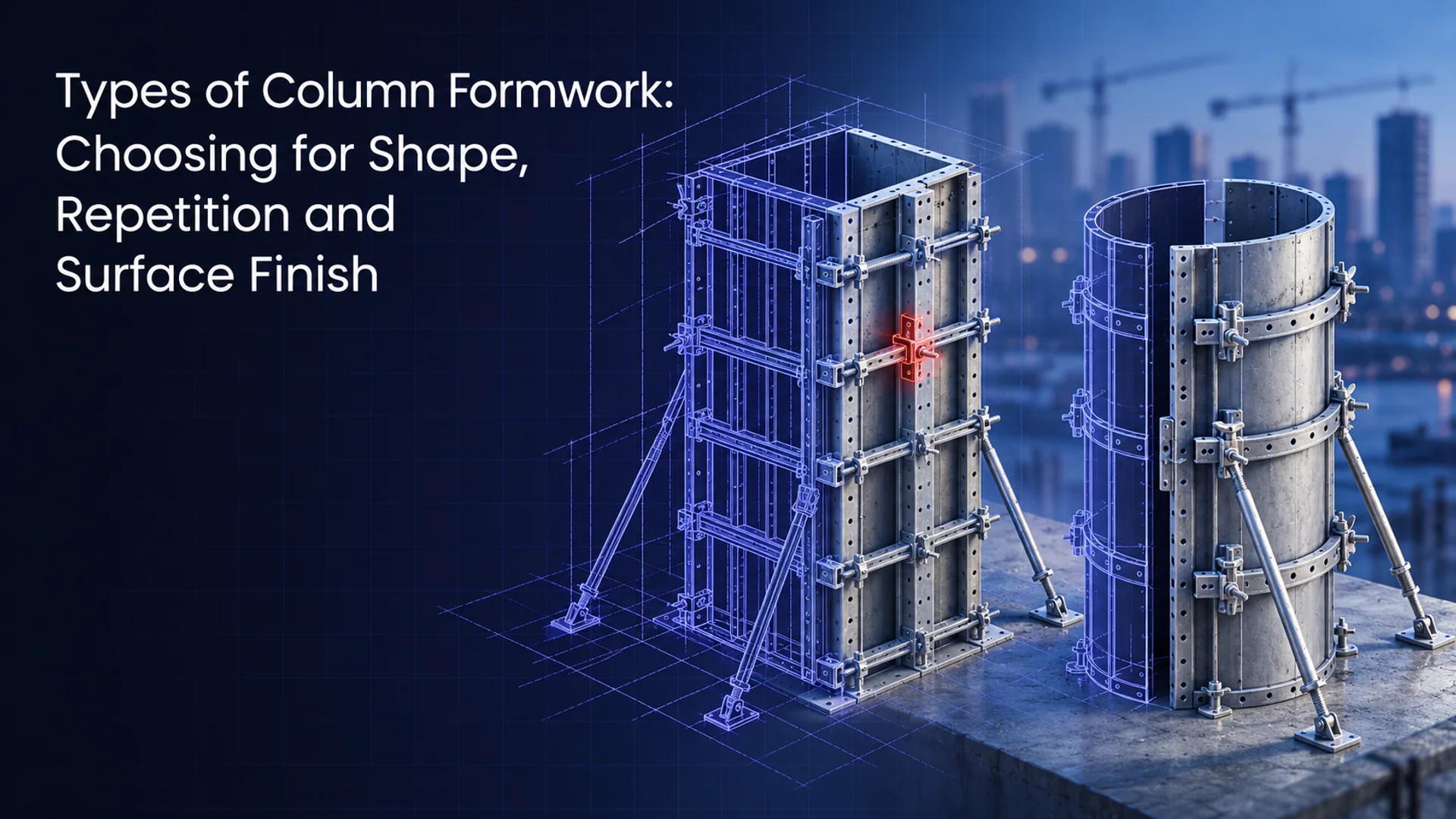
Take all three together and column forms sort cleanly. Shape covers square, rectangular, circular, and the bespoke sections that suit nothing standard. Adjustability separates fixed panels from systems that reset to several sizes. The third describes how the four faces clamp together.
Material sits underneath all three.
A steel face gives a repeatable finish and survives handling. Plywood costs less and absorbs an odd dimension. The Concrete Society notes that available column systems are normally modular, assemble quickly, and adjust on site to give different column sizes.
Internal surfaces vary with the finish required, so a system choice is also a finish choice.
Which column shapes force a different system?
Square and rectangular columns all clamp the same way, whatever their size. Add a round column to the drawing and the whole closure method has to change.
There is no corner to clamp on a circle. The closure moves to a split line running the full height, and that line prints on the concrete where a corner would have hidden it. Circular column formwork trades a corner problem for a seam problem, and seams are harder to hide.
|
Shape |
Closure problem |
How well it repeats |
Usual face |
|---|---|---|---|
|
Square and rectangular |
Four corners, four arrises |
Well, with panel sets |
Steel or plywood |
|
Circular |
One vertical seam |
Poorly, each diameter needs its own form |
Steel half-shells or disposable tube |
|
Tapered |
Corner plus a changing width |
Single use in practice |
Bespoke |
|
Bespoke section |
Every joint is a decision |
None |
Cut on site |
For round columns, the same source describes an alternative. Disposable cardboard tubes with a plastic liner, left in place until the concrete gains strength, then removed. Those need separate working platforms, because a tube carries no integral access.
Square and rectangular columns are where adjustable column formwork earns its keep.
How much pressure does a column form take?
This is the number missing from most column formwork decisions, and it is not a property of the column at all.
Pressure comes from how fast the concrete climbs. A column reaches the top in minutes where a wall takes hours, so the load at the base rises with that rate of climb. Pour identical columns fast on one site and slowly on another, and the two forms are carrying very different loads.
Mix matters too. A wetter mix pushes harder, and so does a richer one.
Clamps are the part that answers all of this. Their job is to hold the form together against the pressure of freshly poured concrete, which is why spacing tightens toward the base where the load is highest.
None of that appears on a materials list. Two identical-looking column forms can still behave very differently. A fast pour is where the gap shows.
Why do corner joints decide the finished column?
Walk past a finished column, and the faces are usually fine. Look at the edges and you find the whole story of how the form behaved.
Almost every defect a column carries starts at a corner or a seam. Grout escapes at the joint. The arris chips when the form is struck. A corner that opens under pressure leaves a fin down the full height of the pour, and somebody has to grind it off.
Sealing strips help at the face.
They do nothing for a frame that flexes, though. Closure force has to come from the clamps and the profile behind them, so corner stiffness comes down to the section you choose.
Plumb is the second corner consequence. A bowed member lets the form lean, and a leaning column is visible from across a floor plate.
How do you pick a column system for a repeat job?
Column count is the figure that lands in the inquiry. On its own, it answers nothing at all. Twenty columns can mean one job or eleven.
Twenty at a single size make a strong case for an adjustable set. Spread those same twenty across eleven sizes and the work is close to bespoke, whatever the brochure promises. Count distinct sections, and count how many times each one comes round again.
|
Project input |
Source document |
What it settles |
|---|---|---|
|
Distinct column sections |
Structural drawings |
Adjustable set or bespoke forms |
|
Tallest single pour height |
Method statement |
Clamp spacing at the base |
|
How fast you pour |
Pour plan |
Design pressure on the form |
|
Mix workability |
Mix design |
How hard that pressure pushes |
|
Required arris and finish |
Architectural specification |
Corner detail and face material |
|
Crane availability |
Site plan |
Whether the form moves in one piece |
The fourth row rarely appears in an inquiry. Identical columns poured at different speeds still need different clamp spacing.
Run the selection on the worst column. The tallest, fastest pour sets the frame, and the rest of the set inherits it.
What goes on the drawing for column formwork components?
A column form looks like four panels and a set of clamps. The part that gets reordered on every batch is neither of those. It sits behind the face.
Column formwork components are the steel members carrying clamp load into the face and holding the corner shut. Section, length, straightness, hole positions. All of it is drawing-specific, because clamp geometry belongs to one system and will not transfer to another.
Three properties of the formwork stiffeners do the work.
Section accuracy, so the clamp seats the same way every time. Straightness across the length, so the face is supported where the design assumed. Hole position, so the clamp lands where the pressure calculation put it.
Mother India Forming Pvt. Ltd. makes column formwork components of exactly that kind. The formwork profiles and stiffeners belong to the heavy-duty structural sections range, cold-rolled and formed to your approved drawing in medium- and high-tensile steel. We develop tooling in-house for your section.
Work out how many column sections actually repeat. The answer usually changes. Share the clamp geometry, the pour rate, and the section drawing, and MIF will tell you what the profile has to hold. Send your drawing.
Frequently asked questions about column formwork
What is column formwork?
The mold that shapes a concrete column and holds it while the concrete sets. Four faces clamp around the steel reinforcement. A column is tall and narrow, so the wet concrete pushes outward against the faces. Side load sizes the form.
Which type of formwork is used for columns?
Adjustable steel or plywood panel systems cover most square and rectangular columns, because one set resets to several sizes. Circular columns use steel half-shells or a disposable tube. Anything tapered or oddly shaped gets built for that column alone.
How to calculate column formwork?
Measure the contact area. Take the perimeter of the finished column, multiply by the pour height, and count only the faces that touch concrete. That gives you the quantity to order or price. It does not tell you how strong the form has to be. Pour rate and mix decide that.
When does adjustable column formwork make sense?
When one set has to serve several column sizes on the same job. Go by distinct sections. A tower with twenty columns at one size suits an adjustable set, while twenty columns across eleven sizes usually ends up bespoke, because resetting costs more than the sharing saves.
Why is circular column formwork treated separately?
A round column has no corner to clamp. Closure moves to a vertical seam running the full height. The seam then prints on the concrete where a corner would have hidden it. Each diameter also needs its own form, so circular work repeats badly against square columns.
What pressure should a column form be designed for?
Whatever your pour rate and mix produce. Concrete in a column climbs fast, so pressure at the base rises with that speed. The same form can see very different loads on two sites, so pour rate belongs in the inquiry and not in an assumption.
What information does a profile supplier need?
The approved section drawing with length and hole positions, the steel grade and coating, your straightness tolerance, and the forecast quantity with call-off pattern. Send the clamp geometry too, because the profile has to seat that clamp identically on every panel in the set.