Backpropping is one word doing the work of two, and only one of the two events it describes lets a young slab take its own weight.
ACI 347 keeps them apart. Site language usually does not, which is how a floor gets stripped earlier than the designer intended and nobody notices until a level is out.
Slab formwork is unusual in needing that vocabulary at all. The deck comes away in two stages, and the floor takes over its own weight somewhere between them, so the words covering that middle stage carry real consequences.
The short version
- Suspended slabs use four families of formwork, from site-cut timber up to drop-head systems.
- Preshoring and reshoring are separate events, and only one lets the young slab sag.
- A drop-head frees the panel early while the props stay, which shortens the cycle.
- Bay repetition picks the family, and crane access settles the close calls
- Under every system sits a bearer and a prop head, and those are what an OEM buys
What are the types of slab formwork?
Start with what is above your head and work down. A face, with joists behind it, a bearer under those, and props carrying the lot to the floor below. Every system here arranges the same four layers. They differ only in how much of that stack arrives already assembled, and in what has to come apart again before the next bay.
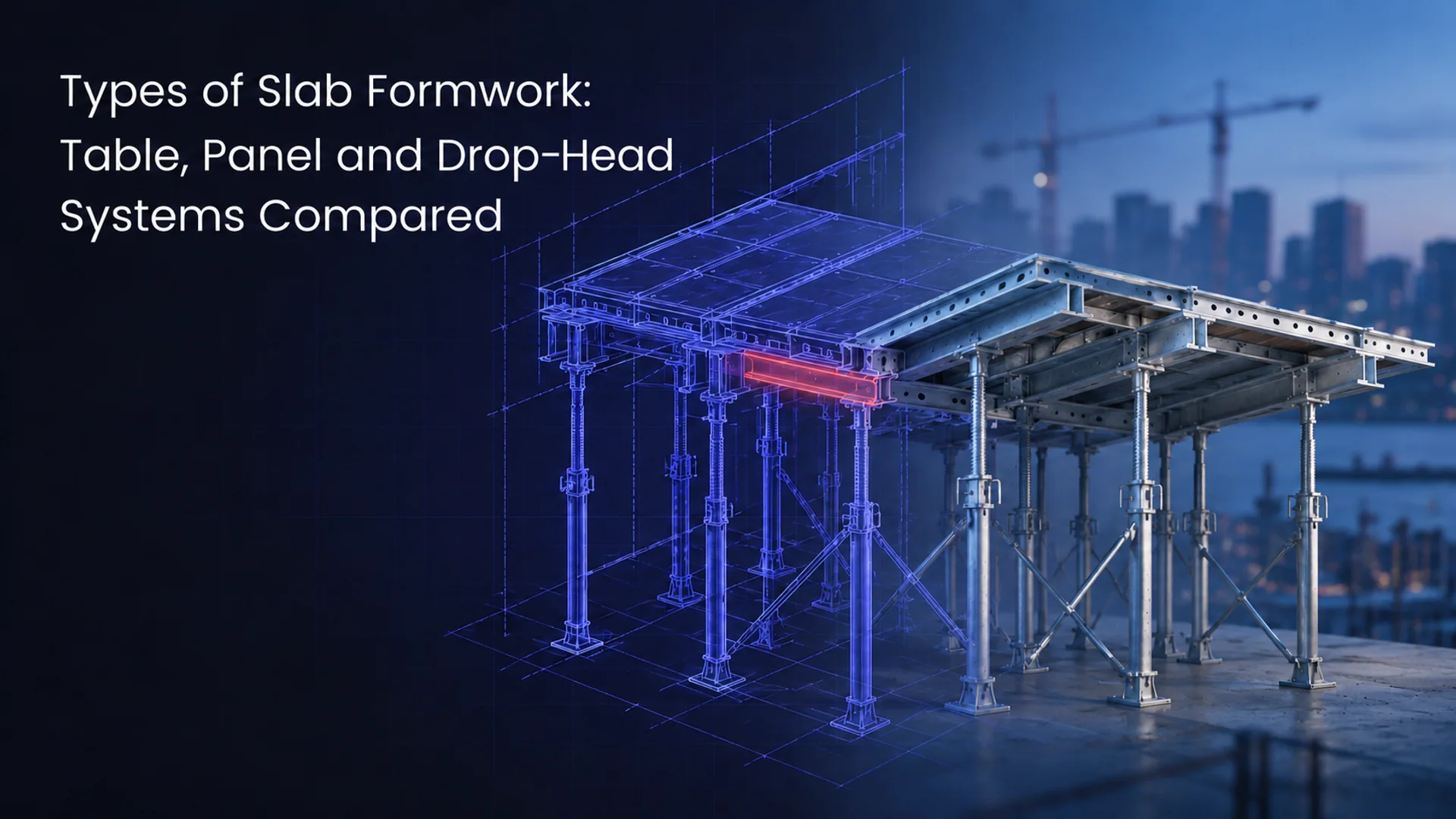
Four families cover suspended work. Traditional timber gets cut on site over props. Panel-and-prop systems put made panels on props with a head plate. Table forms are assembled once, then flown bay to bay by crane. Drop-head systems let the panel come away from a prop head that stays loaded.
Ground slabs are a different problem for a different reader. Everything here concerns a slab spanning between supports.
Under the soffit sit secondary joists, then a primary bearer, then the props. Four layers, four interfaces, and each one belongs on somebody’s drawing.
How do table and panel slab systems differ in practice?
Watch a floor cycle twice, and the difference stops being about speed. The real question is narrower. How much of the deck survives the trip to the next bay intact?
A table travels as one unit, so its cycle runs strip, fly, set, pour. A panel system comes apart every single time, which puts assembly labor on every floor of the building. Beam and slab formwork sits between the two, because a downstand beam needs a soffit level of its own.
|
System |
What moves between pours |
Effect on the floor cycle |
Where the OEM content sits |
|---|---|---|---|
|
Traditional timber |
Nothing; it gets rebuilt |
Slowest, highest labor |
Props and their heads |
|
Panel and prop |
Panels, by hand |
Moderate, assembly every floor |
Panel edge profile, prop head |
|
Table form |
The whole table, by crane |
Fastest where bays repeat |
Primary bearer, frame, lifting points |
|
Drop head |
Panels only, props stay |
Fast, frees the panel early |
Drop head casting, bearer seat |
Flying a table needs a crane and a clear edge to pass through, and on a plate where bays repeat, nothing else keeps up.
Drop-head systems win on a different axis. The head frees the panel while the props carry on holding the slab, so the panel is back in circulation well before striking time is up.
Is backpropping the same as reshoring?
Give the word backpropping to two crews, and you can get opposite sequences. Only one of them lets the young slab sag first. ACI 347 keeps the two cases apart, and so should your drawing.
Reshores go under a slab after the original forms and shores have come away across a large area. By then the slab has already deflected, carrying its own weight plus the construction load before the reshores arrive.
Preshores work the other way round. They go in under selected panels before any primary shore comes out, then stay put while the rest of the bay is stripped a small area at a time. The slab never gets a chance to take its own weight.
One sequence lets the young slab sag. The other never lets go.
Call both of them backpropping, and you bury a decision that belongs to the designer. The sequence has to be signed off before anyone strips a bay on that floor. That choice sets how early a floor can be stripped. The same choice sets how many prop sets the site has to own, which is a capital question nobody raises at tender. Props stay under a slab for days after the pour, so a three-day floor cycle can put four sets in circulation at once. Ask which one the drawing means.
Striking time caps the answer either way. Props stay under slabs spanning up to 4.5 m for seven days, and twice that over longer spans, with beams held longer again.
Which floor geometry suits which system?
Look at the floor plate before looking at any brochure. Count how many bays are the same, then check whether a table can get out past the edge.
Between them, those questions settle most of it. A plate of identical bays suits table forms, because the table gets made once and flown many times. Where every bay differs, panels win, since panels reconfigure and a table only ever fits the bay it was built for.
The guide adds a point worth passing back up to the designer. Where commercially available forming systems are used, it advises basing the structure on one standard depth wherever possible. Depth variation costs nothing on a drawing and plenty on site. Fixing it upstream is close to free.
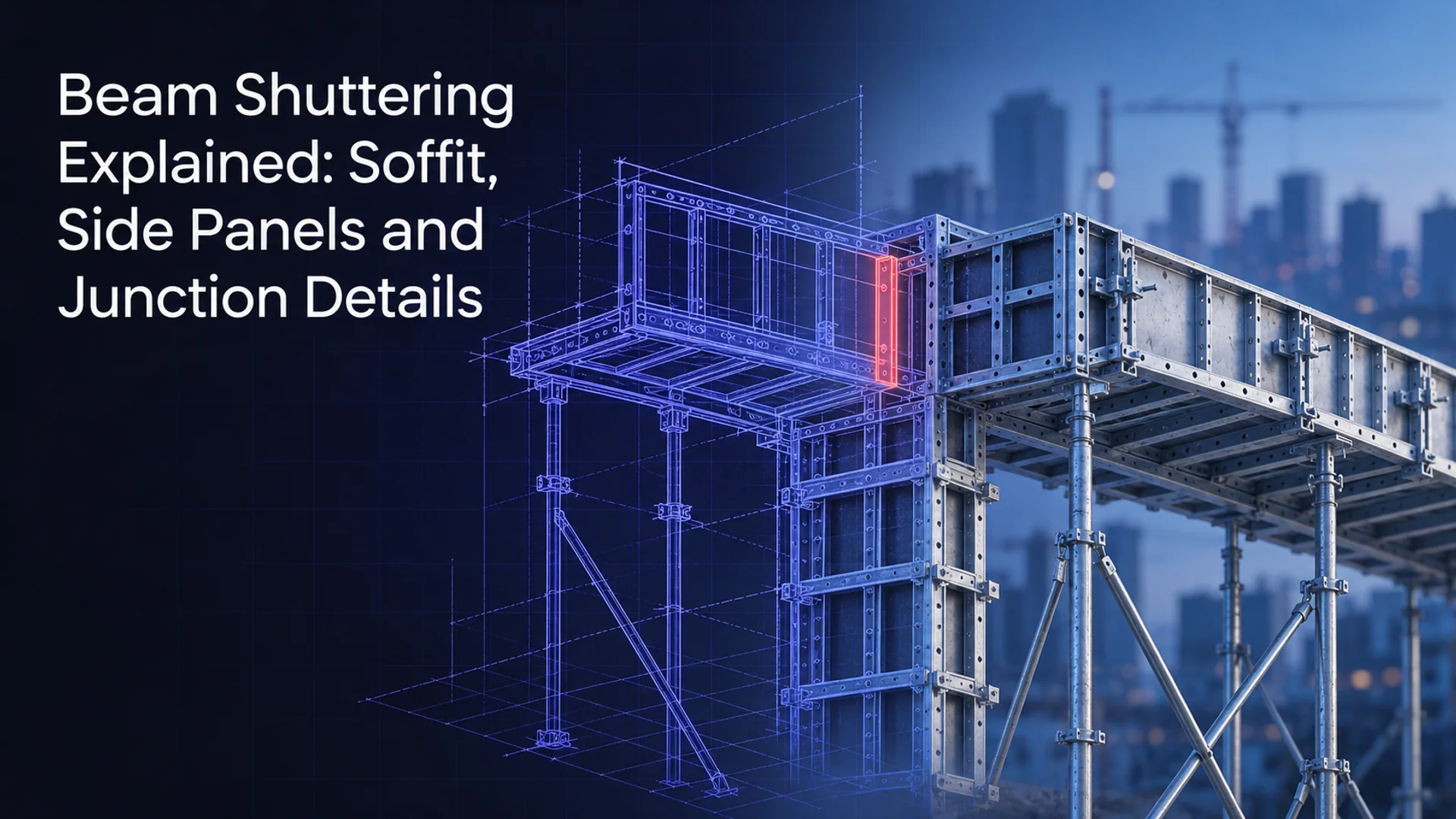
Beam and slab arrangements make this harder. A downstand beam drops the soffit. The slab system has to step or stop at the beam. Those edges are also where props need bracing and a tie back to their neighbors.
Crane availability settles anything close, because no crane means no table forms, whatever the bay repetition says.
What does each system ask of the bearer and prop interface?
System brochures photograph the finished deck from below, where the camera sees a panel and some props.
Hidden between those two is a stack of four interfaces, running from the soffit face down to the prop head. That stack is where a component supplier lives. Each interface belongs on somebody’s drawing, and they are rarely the same somebody.
|
Interface |
Table form |
Panel and prop |
Drop head |
|---|---|---|---|
|
Primary bearer |
Built into the frame, long spans |
Separate, spans prop to prop |
Seats into the drop head casting |
|
Secondary joist |
Fixed into the table |
Loose, laid across bearers |
Laid across bearers |
|
Prop head |
Carries the table leg |
Plate under the bearer |
Casting with a release wedge |
|
Panel edge |
Welded frame perimeter |
Roll formed edge profile |
Roll formed edge profile |
|
Repeat tolerance |
Set once at assembly |
Batch to batch on every panel |
Batch to batch, plus casting fit |
Two of those rows are pure component supply, and both run through the same manufacturing services.
Soffit flatness is the test that finds everything else. A bearer that bows between props moves the soffit, and a panel edge that drifts in section leaves a step between panels. Both show on the finished concrete, and a soffit is usually on view.
What goes in a slab formwork component brief?
Give the same brief to two suppliers, and you can get different steel, because the names change between systems while the requirements do not.
Six things settle it. Section, length, straightness tolerance, hole positions, coating, forecast quantity. Then add prop head geometry and the bearer seat detail, because a profile that fits the head on one system will sit proud on another. Proud means a step in the soffit.
Mother India Forming Pvt. Ltd. makes the roll-formed part of that assembly. The formwork profiles and stiffeners come from the heavy-duty structural sections range, cold roll-formed to your approved drawing in medium- and high-tensile steel, galvanized. We develop tooling in-house for your section, and a line is dedicated to your order quantity.
Still deciding which family suits your floor plate? Send MIF the bearer and panel edge drawings with your forecast quantities. You get a feasibility view on the sections before any tooling is cut. Talk to the MIF team.
Frequently asked questions about slab formwork.
What is formwork in a concrete slab?
The temporary deck that holds wet concrete at the right level until the floor can carry itself. Behind that face sit joists and bearers, with props running down to the floor below. Once the concrete gains strength, the deck comes away and the slab takes over.
What are the two main types of slab formwork?
Decks that come apart and decks that move whole. A panel-and-prop deck gets dismantled on every floor, which suits bays that keep changing. A table form travels as one unit by crane, which suits a plate of identical bays. A drop-head deck sits in the first group, with an early panel release built in.
What is the formula for calculating slab formwork?
Measure the contact area. For a plain suspended slab, it is the soffit area plus the perimeter edge multiplied by the slab depth. Downstand beams add two sides and a bottom. The figure gives you the quantity for pricing and ordering. Deck strength is a separate calculation.
What is the difference between preshoring and reshoring?
Reshores go under a slab that has already been stripped across a large area, so the slab deflects and carries its own weight first. Preshores go in before any primary shore comes out, and they stay with their panels while the rest of the bay is stripped in small areas. Both terms are defined in ACI 347.
How long do props stay under a suspended slab?
On slabs spanning up to 4.5 m, around seven days. Longer spans roughly double that. Beams hold their props longer again. Treat published retention periods as a minimum, because a designer can extend them for a particular mix or a cold spell.
Do drop-head systems shorten the floor cycle?
Panel turnaround shortens, and panel turnaround is usually the constraint. The head frees the panel while the prop stays loaded under the slab, so panels return to circulation before the retention period is over. The props themselves stay for the full period, so prop stock does not shrink.
What is a primary bearer in slab formwork?
The member spanning prop to prop. A bearer carries the secondary joists, and those carry the soffit, which makes it the most heavily loaded roll-formed section in a panel or drop-head deck. Bow in a bearer moves the soffit directly, so straightness across the length is the property to specify.